

Top
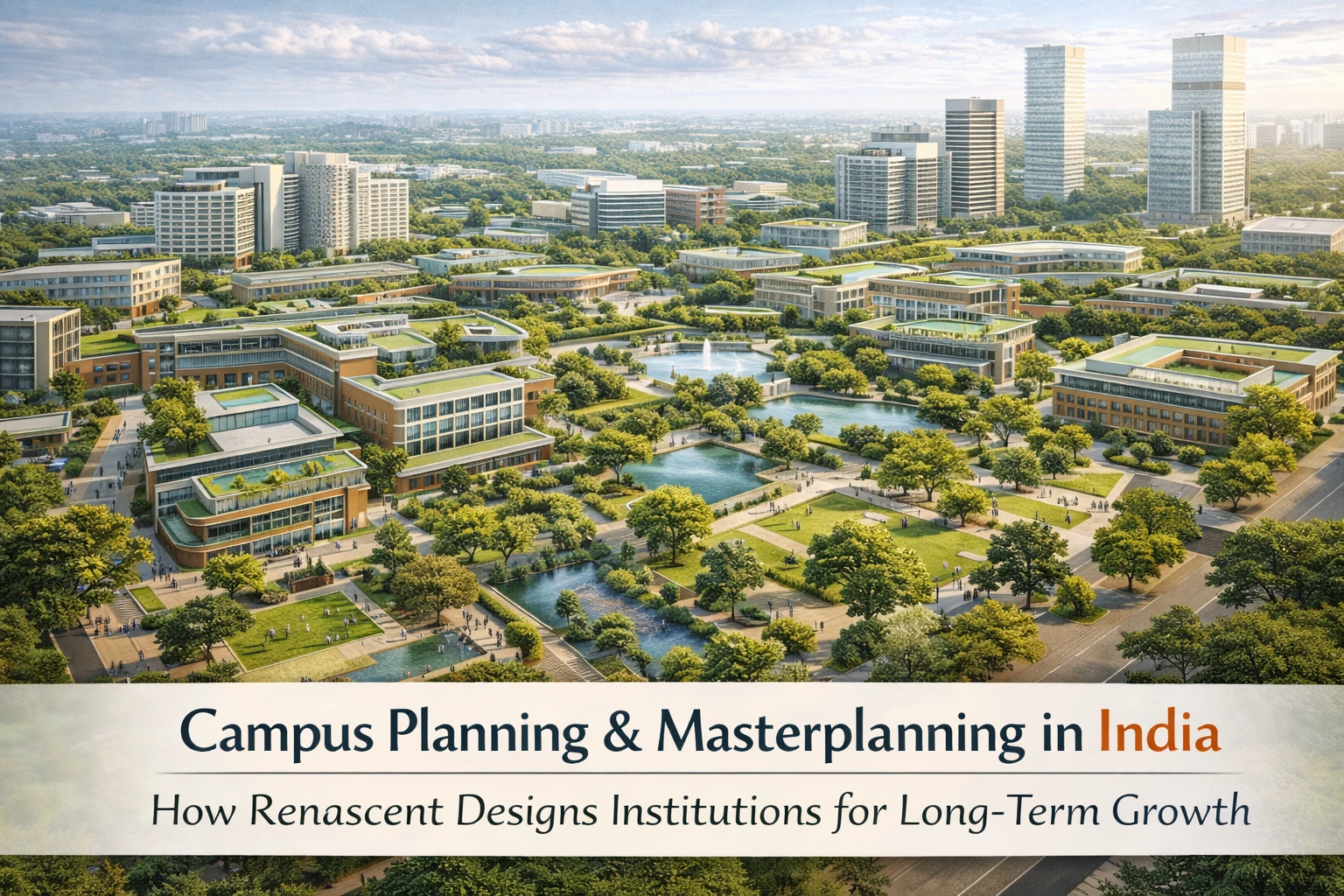
Campus Planning & Masterplanning in India

Campus Planning & Masterplanning in India

Introduction: The Strategic Importance of Campus Planning in India

Across India, campuses are evolving far beyond their traditional roles. Hospitals are becoming healthcare ecosystems, universities are transforming into innovation districts, and institutional developments are expected to operate as self-sustaining environments rather than isolated buildings.

In this context, campus planning and masterplanning have emerged as one of the most critical disciplines in architecture today. It is no longer enough to design individual structures well; the success of large institutional developments depends on how thoughtfully they grow, adapt, and function over decades.

By 2026, masterplanning in India is increasingly shaped by long-term thinking – balancing immediate needs with future expansion, operational efficiency with human experience, and built form with environmental responsibility. Renascent’s approach to campus planning reflects this shift: designing institutions not as static entities, but as living frameworks built to evolve.

1. From Buildings to Systems: The New Role of Campus Masterplanning

Traditional campus design often focused on placing buildings efficiently on a site. Modern masterplanning in India, however, views campuses as interconnected systems – spatial, social, infrastructural, and ecological.

A well-planned campus integrates:

  • Movement systems (pedestrian, vehicular, service)
  • Open spaces and social zones
  • Utilities and infrastructure networks
  • Phased growth strategies
  • Environmental and climatic responses

Renascent approaches campus planning as a strategic exercise rather than a purely architectural one. The emphasis is on understanding how people will move, interact, and operate within the campus over time, ensuring that each development phase strengthens the whole rather than creating fragmentation.

2. Designing for Growth Without Disruption

One of the biggest challenges in institutional masterplanning is growth. Campuses rarely emerge fully formed; they expand incrementally as demand, funding, and functions increase.

In India, many institutions struggle with unplanned expansions that result in poor circulation, infrastructure overload, and operational inefficiencies. Future-ready campus planning anticipates growth from the outset.

Renascent embeds scalability into masterplans by:

  • Identifying logical expansion zones
  • Creating flexible land-use strategies
  • Planning infrastructure capacity beyond immediate needs
  • Ensuring future buildings integrate seamlessly with existing ones

This foresight in campus design India allows institutions to grow organically without disrupting daily operations or compromising spatial quality.

3. Human-Centric Campuses: Designing for Daily Experience

While masterplans often deal with large-scale decisions, their success is ultimately judged at the human scale. Campuses are places where people spend significant portions of their lives – studying, working, healing, or collaborating.

Modern campus planning prioritises:

  • Walkability and intuitive navigation systems
  • Comfortable distances between functional zones
  • Shaded outdoor movement corridors for Indian climates
  • Active social spaces that encourage interaction

Renascent’s campus design focuses on legibility and comfort. Clear spatial hierarchies, well-defined public and private zones, and thoughtfully designed open spaces ensure that campuses feel navigable rather than overwhelming.

4. Climate-Responsive Planning in the Indian Context

India’s diverse climatic conditions – from extreme heat to heavy monsoons – make climate-responsive planning essential at the campus scale. Masterplanning in India must address these environmental challenges strategically.

Effective campus planning uses climate as a design driver rather than a constraint. This includes:

  • Orienting buildings to minimise solar heat gain
  • Using landscape buffers to reduce microclimate stress
  • Designing shaded pedestrian networks
  • Leveraging wind movement for passive cooling

Renascent integrates environmental strategies early in the masterplanning process, ensuring that sustainability is embedded into the campus structure rather than retrofitted later. This approach results in lower energy consumption, improved comfort, and long-term operational savings.

5. Mobility, Circulation & Campus Logistics

As campuses grow larger and more complex, movement planning becomes a critical success factor. Poor circulation can lead to congestion, confusion, and inefficiency – especially in healthcare and educational environments.

Modern campus masterplanning clearly separates:

  • Pedestrian movement networks
  • Vehicular access and parking zones
  • Emergency response routes
  • Service and utility circulation paths

Renascent emphasises intuitive circulation hierarchies that reduce conflicts between different user groups. Pedestrian-first planning, logical drop-off zones, and efficient service routes ensure that daily operations run smoothly while maintaining a calm, people-friendly environment.

6. Integrating Open Spaces as Functional Infrastructure

Open spaces in campuses are no longer treated as leftover areas between buildings. By 2026, landscape design plays a functional and social role in institutional masterplanning.

Well-designed open spaces in campus design India:

  • Support informal learning and collaboration
  • Improve mental wellbeing through biophilic design
  • Act as climate moderators and heat sinks
  • Create visual relief in dense institutional developments

Renascent views landscape as an extension of architecture. Courtyards, plazas, shaded lawns, and pedestrian spines are planned as active zones that support daily life rather than purely aesthetic features. Learn about biophilic design principles from Terrapin Bright Green’s research.

7. Infrastructure Planning for Longevity

Behind every successful campus lies a robust infrastructure network. Water, power, waste management, and digital systems must be designed to support both present and future needs in masterplanning in India.

In many Indian campuses, infrastructure becomes a constraint due to short-term planning. Renascent addresses this through:

  • Designing scalable utility corridors
  • Planning decentralised infrastructure where appropriate
  • Allowing for future technology upgrades
  • Ensuring ease of maintenance and access

This infrastructure-first mindset in campus planning ensures that campuses remain operationally efficient even as they expand or evolve over decades.

8. Institutional Identity Without Monumentality

Institutions often seek strong architectural identities, but in large campuses, identity must emerge from coherence rather than isolated iconic buildings.

Modern masterplanning focuses on:

  • Consistent spatial language and design vocabulary
  • Harmonised building heights and scales
  • Material continuity across different phases
  • Unified public realms and circulation networks

Renascent’s campus design prioritises clarity and cohesion, allowing individual buildings to express function while contributing to a larger, recognisable campus character. This approach avoids visual chaos and reinforces institutional identity over time.

9. Masterplanning for Healthcare, Education & Mixed-Use Institutions

Different institutions have different operational needs, yet they share common masterplanning principles that Renascent applies strategically:

Healthcare Campus Planning

  • Strict zoning for infection control
  • Emergency access prioritisation
  • Separated patient, staff, and service circulation
  • Modular expansion planning for future departments

Educational Campus Design

  • Academic clustering for interdisciplinary interaction
  • Flexible learning space frameworks
  • Student life and residential zone integration
  • Research and innovation district planning

Institutional & Mixed-Use Campuses

  • Controlled environments with room for innovation
  • Public-private interface management
  • Mixed-use zone planning for community integration
  • Phased development with interim use strategies

Renascent tailors each masterplan to the specific functional and cultural context of the institution, ensuring that planning strategies align with real-world usage rather than generic templates.

10. Planning for the Unknown Future

Perhaps the most critical role of campus masterplanning today is preparing for uncertainty. Changes in technology, pedagogy, healthcare delivery, and environmental conditions are inevitable.

Future-ready campuses through strategic masterplanning in India are designed with:

  • Flexible land-use frameworks that accommodate change
  • Adaptable building typologies for multiple functions
  • Infrastructure that supports technological evolution
  • Clear long-term development logic and phasing

Renascent’s approach acknowledges that not everything can be predicted – but thoughtful campus planning can create resilience. By designing systems rather than fixed outcomes, campuses are better equipped to respond to future needs and opportunities.

Conclusion: Building Campuses That Outlast Generations

Campus planning and masterplanning is ultimately an act of responsibility. Institutional developments often serve communities for decades, sometimes centuries. Decisions made at the masterplanning stage have long-lasting consequences on usability, sustainability, and institutional identity.

Renascent’s approach to campus planning in India reflects a deep understanding of this responsibility. By combining human-centric design, climate responsiveness, operational intelligence, and long-term vision, campuses are designed not just to function – but to endure and evolve.

As India continues to invest in healthcare, education, and institutional infrastructure, thoughtful masterplanning will define the success of these investments. The campuses that thrive will be those planned with patience, clarity, and an unwavering focus on people’s daily experiences.

In the end, great campuses are not just built; they are carefully planned for life, growth, and generations to come.

Explore Renascent’s expertise in creating sustainable institutional environments through our hospital architecture trends 2026 or learn about our patient-centric design approach for healthcare facilities.

Ready to plan your institution’s future? Contact Renascent’s masterplanning team for strategic campus design that grows with your vision.