

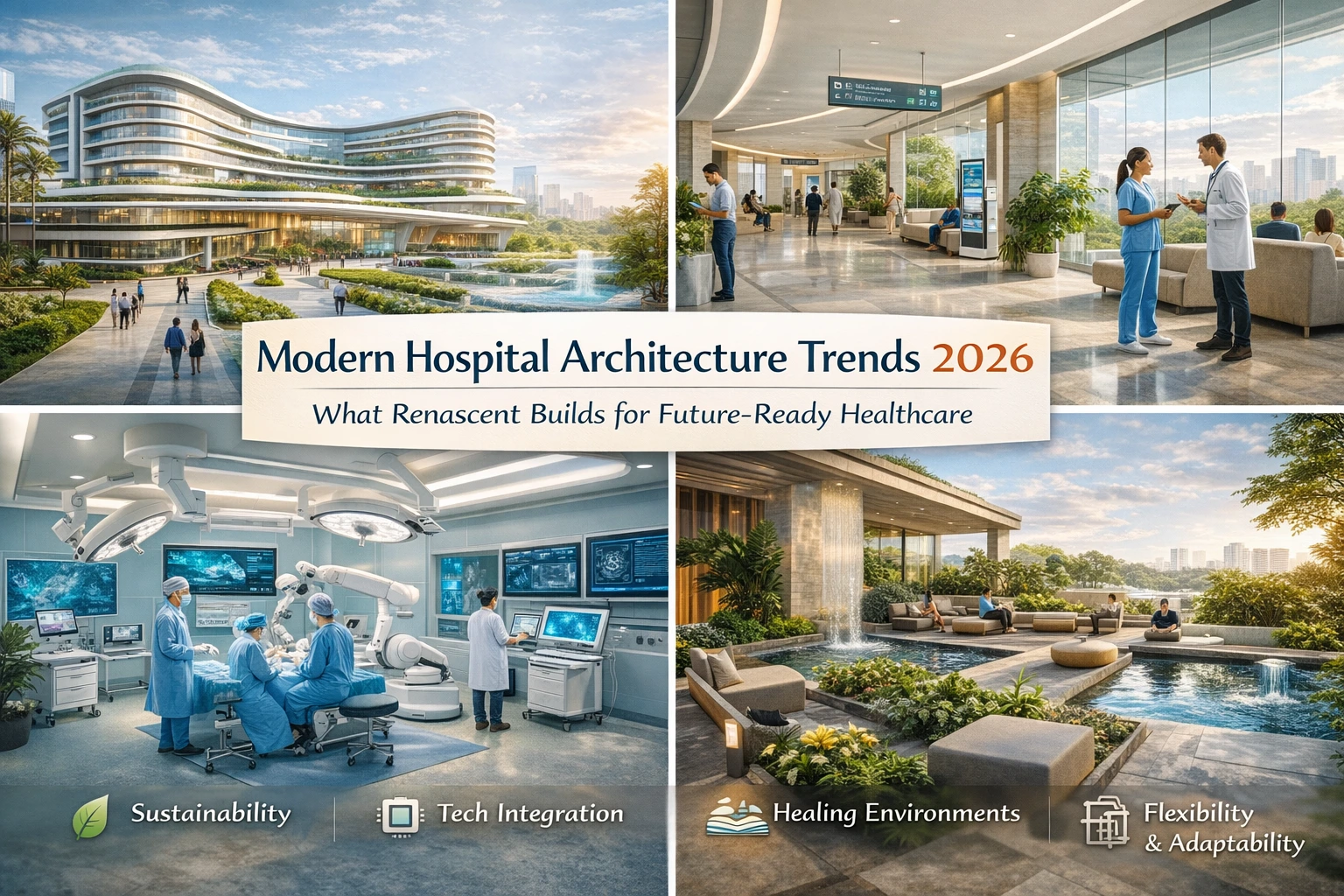
Introduction: The Transformation of Healthcare Architecture in India
Healthcare architecture in India is undergoing a quiet but decisive transformation. Hospitals are no longer viewed merely as clinical infrastructure designed to house equipment and medical professionals. Instead, they are increasingly recognised as complex, human-centred environments that influence patient recovery, staff efficiency, emotional wellbeing, and long-term public health outcomes.
As India prepares for the next decade of healthcare delivery – driven by population growth, medical tourism, technology adoption, and evolving patient expectations – hospital architecture trends 2026 demand a future-ready approach. It must balance efficiency with empathy, resilience with adaptability, and clinical precision with human comfort.
Modern hospital architecture today is less about iconic façades and more about intelligent planning. It is about creating buildings that heal, adapt, and endure. This is where Renascent’s design philosophy aligns closely with emerging global and Indian healthcare architecture trends – building hospitals that are not just functional for today, but robust for the future.
1. The Shift from “Hospital” to “Healing Environment”
One of the most defining hospital architecture trends 2026 is the shift away from institutional, intimidating spaces toward environments that actively support healing. Research-backed design strategies now inform how light, colour, acoustics, spatial flow, and materiality impact patient outcomes.
Future-ready hospitals are designed to reduce anxiety, promote dignity, and restore a sense of control for patients. This includes intuitive wayfinding, uncluttered circulation, access to daylight, and visual connections to nature. Renascent approaches modern hospital design with a strong emphasis on spatial psychology – recognising that the built environment plays a role in emotional and physical recovery.
Rather than designing hospitals as purely operational machines, the focus is on creating calm, legible spaces that feel humane even under high clinical intensity.
2. Flexibility as a Core Planning Principle
If the pandemic taught the healthcare industry anything, it is that hospitals must be able to adapt – quickly and efficiently. In 2026, flexibility is no longer a desirable feature; it is a necessity.
Modern hospital architecture prioritises:
- Modular planning systems
- Expandable service zones
- Flexible ward layouts
- Convertible ICU and isolation areas
Renascent integrates adaptability at the master planning stage itself. Structural grids, MEP planning, and circulation systems are designed to allow future expansion or internal reconfiguration without disrupting hospital operations.
This foresight ensures that future-ready hospitals remain relevant even as medical technologies, patient loads, and care models evolve – protecting long-term investments for healthcare providers.
3. Smart Hospitals and Technology-Integrated Design
Technology is no longer layered onto hospitals after construction; it is embedded into architectural planning from day one. By 2026, hospitals are expected to support advanced digital infrastructure, AI-assisted diagnostics, telemedicine, and automated logistics.
Renascent’s hospital architecture designs anticipate this shift by aligning architectural layouts with smart systems integration. This includes:
- Dedicated zones for digital diagnostics and command centres
- Seamless integration of building management systems (BMS)
- Efficient routing for automated transport and supply systems
- Data-ready infrastructure that supports future upgrades
Rather than allowing technology to dictate space awkwardly, the architecture supports technology invisibly – ensuring that innovation enhances care without overwhelming users.
4. Patient-Centric Zoning and Clear Functional Segregation
One of the most critical aspects of modern hospital design is functional clarity. In high-performing hospitals, patients, visitors, staff, supplies, and waste all move through carefully segregated pathways.
Renascent emphasises zoning strategies that minimise cross-traffic and confusion. Patient-centric zoning ensures:
- Shorter travel distances for patients
- Reduced stress through clear navigation
- Improved infection control
- Greater operational efficiency
Outpatient departments, diagnostics, emergency care, inpatient wards, and support services are planned as interlinked yet independent systems. This approach not only improves patient experience but also optimises staff workflows – an essential factor in high-pressure healthcare architecture environments.
5. Designing for Staff Wellbeing and Operational Efficiency
A future-ready hospital is not just patient-centric; it is staff-centric as well. Doctors, nurses, and healthcare workers operate in high-stress environments, often for long hours. Architecture plays a silent yet powerful role in supporting their performance and wellbeing.
Hospital architecture trends 2026 place renewed emphasis on:
- Efficient staff circulation
- Access to daylight and rest areas
- Reduced walking distances through smart adjacencies
- Ergonomically planned workspaces
Renascent integrates staff experience into hospital planning, recognising that better working conditions directly translate into improved patient care. The design intent is to reduce fatigue, improve visibility, and create logical layouts that support fast, accurate decision-making.
6. Sustainability and Climate-Responsive Healthcare Design
As hospitals are among the most energy-intensive building types, sustainability has become a central concern in healthcare architecture. In 2026, future-ready hospitals are expected to reduce environmental impact without compromising clinical performance.
Renascent approaches sustainability as a design strategy rather than an add-on. Climate-responsive planning includes:
- Optimised building orientation
- Passive daylighting and shading strategies
- Energy-efficient façades and systems
- Water conservation and waste management planning
By responding to local climate conditions and site context, hospitals become more resilient, cost-efficient, and environmentally responsible – while also offering more comfortable interior environments.
7. Infection Control Through Architectural Planning
Post-pandemic hospital architecture trends 2026 place heightened emphasis on infection prevention through spatial planning. Architecture is considered a frontline defence against cross-contamination.
Key planning strategies include:
- Separate clean and dirty circulation paths
- Negative pressure isolation zones
- Decentralised nursing stations
- Easily sanitised materials and finishes
Renascent integrates infection control principles into the spatial logic of hospitals, ensuring that safety is embedded within the building’s DNA rather than reliant solely on protocols and equipment.
8. Contextual Design for Indian Healthcare Realities
While global trends influence modern hospital architecture, Indian healthcare presents unique challenges – high patient volumes, diverse demographics, mixed public-private models, and varying climatic conditions.
Renascent’s hospital design responds to these realities by grounding global best practices in local context. This includes:
- Designing for high footfall without overcrowding
- Accommodating attendants and family members sensitively
- Balancing cost efficiency with long-term durability
- Respecting cultural and social behaviours
The result is healthcare architecture that is modern yet grounded – globally informed but locally relevant.
9. Long-Term Master Planning for Healthcare Campuses
Large hospitals increasingly function as healthcare campuses, integrating diagnostics, research, teaching, housing, and public amenities. In 2026, hospital master planning extends beyond the building to the ecosystem around it.
Renascent approaches hospital projects with a long-term vision – planning phased growth, future buildings, circulation networks, and infrastructure from the outset. This ensures that expansion does not disrupt ongoing operations and that the campus evolves cohesively over time.
10. Architecture That Anticipates the Future of Care
Ultimately, modern hospital architecture in 2026 is about anticipation. It is about designing spaces that can respond to unknown future demands – whether technological shifts, healthcare crises, or changing patient expectations.
Renascent’s approach to future-ready healthcare design lies in asking the right questions early:
- How will care delivery evolve?
- What systems need flexibility?
- How can architecture support both efficiency and empathy?
By addressing these questions through integrated planning, coordination, and design intelligence, hospitals become resilient assets rather than rigid infrastructures.
Conclusion: Building Hospitals for Tomorrow, Today
As healthcare delivery grows more complex, hospital architecture must evolve beyond conventional templates. The future belongs to hospitals that are adaptable, human-centric, technologically prepared, and deeply contextual.
Renascent’s work reflects this evolution – where design is not about visual statements alone, but about performance, longevity, and human experience. By aligning architectural thinking with healthcare realities and future demands, Renascent contributes to shaping hospitals that truly serve the next generation of care.
In 2026 and beyond, modern hospital architecture will not be measured by how impressive it looks – but by how well it works, heals, and endures. Explore how Renascent is redefining hospital design in India for a healthier future.