

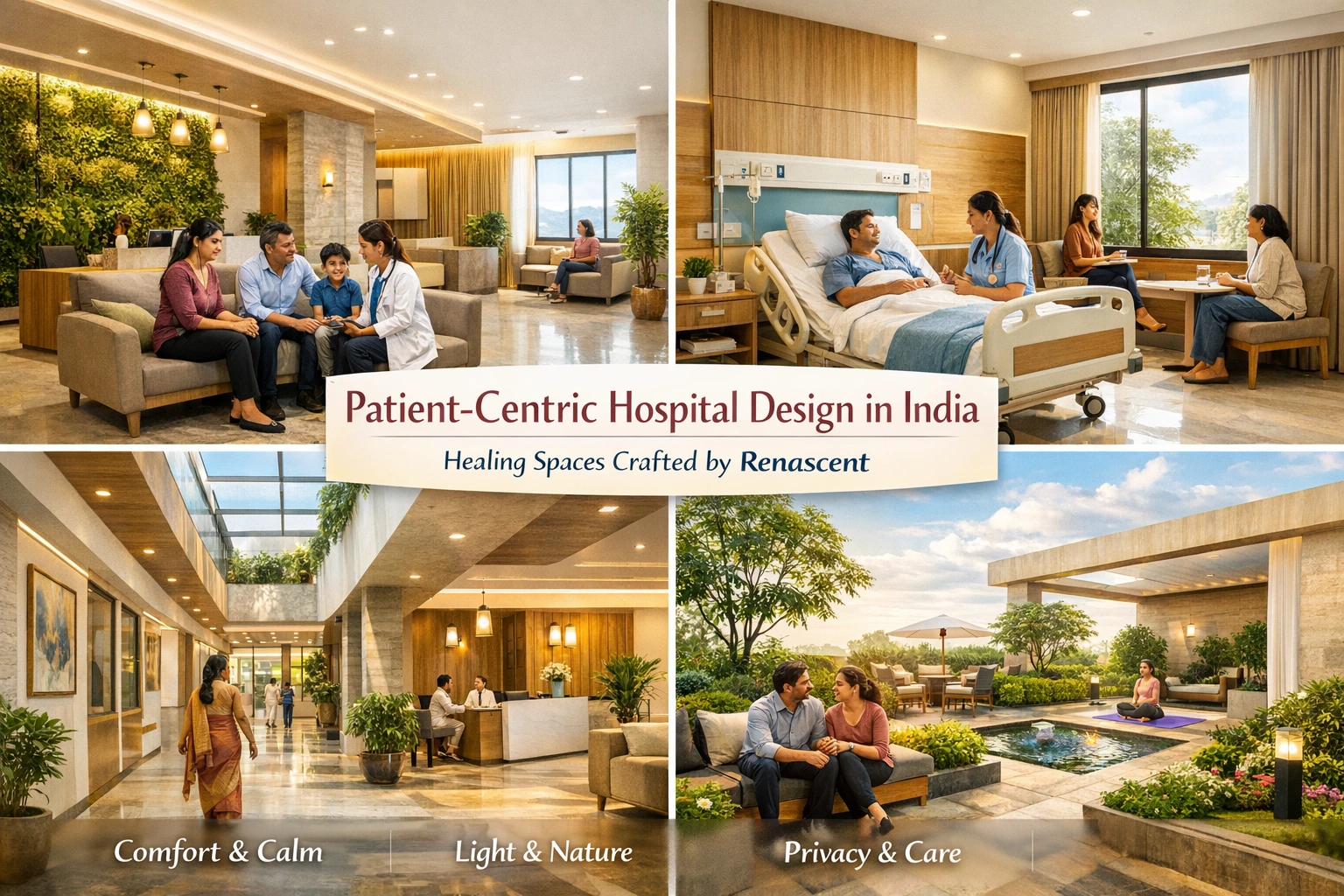
Introduction: The Evolution of Patient-Centric Hospital Design in India
Hospitals are often designed to be functional first – corridors that feel endless, harsh lighting, waiting areas that drain energy, and spaces that unintentionally make people more anxious than they already are. In India, where hospitals are frequently high-traffic and high-pressure environments, this becomes even more pronounced. But the conversation around patient-centric hospital design is changing, and for good reason.
Today, patient-centric hospital design is no longer just a “nice to have.” It is becoming a necessity. Because healing isn’t only about medicine and machines. It is also about comfort, clarity, movement, light, privacy, and how a space makes a patient and their family feel. This is exactly where Renascent’s approach stands out – designing hospitals not just as clinical buildings, but as healing environments that support recovery, trust, and human dignity.
This blog takes a closer look at how Renascent creates patient-centric hospitals in India, blending smart planning with empathy-led design. For more insights on healthcare architecture trends, check out ArchDaily’s hospital design resources.
Understanding True Patient-Centric Hospital Design
Patient-centric design is often misunderstood as simply “pretty interiors” or “hotel-like hospitals.” But in reality, it goes far deeper than aesthetics. It’s a design philosophy where every decision – from layout to signage to daylight – is made with the patient experience in mind.
A truly patient-centric hospital aims to reduce stress, improve comfort, make navigation easier, and support caregivers and medical staff. It also ensures hospitals remain efficient for clinicians, because smoother workflows directly impact patient outcomes.
In India, this becomes particularly important because hospitals are busy, multi-user ecosystems. Along with patients and doctors, hospitals manage attendants, visiting family members, support teams, deliveries, emergencies, and constant movement. The role of patient-centric design is to create order within that intensity, without making the building feel cold or chaotic.
Designing for India’s Healthcare Reality: A Patient-Centric Approach
Indian hospitals operate differently from many global healthcare environments. There’s a cultural reality that most patients come with family – sometimes several members. Waiting areas often become emotional hubs, and healthcare is deeply connected to trust and reassurance.
Renascent designs with this context in mind. A hospital here cannot be designed like a cookie-cutter international template. The building needs to work for India’s scale, sensitivity, and climate through thoughtful patient-centric hospital design.
Key Elements of India-Specific Patient-Centric Design:
- More intuitive circulation pathways for easier navigation
- Waiting areas that accommodate extended families without feeling cramped
- Better ventilation planning for tropical climates
- More daylight integration where possible to reduce depression
- Visual calmness to balance operational intensity
In short, patient-centric design decisions must acknowledge that patients don’t experience hospitals alone – they experience them with their families, emotions, and uncertainty. For more on healthcare waiting area design, see Healthcare Design Magazine.
The First Impression: Entry Experience in Patient-Centric Hospitals
The “entry moment” of a hospital impacts how safe and reassured a patient feels within the first few minutes. A confusing entrance, unclear reception, or overcrowded lobby can spike stress immediately. This is why patient-centric planning begins at the doorstep.
Renascent focuses on creating clear entry sequences – spaces that guide people naturally without overwhelming them. A good hospital entry in a patient-centric design is not loud with signage and activity. It’s organised, visually legible, and calming.
Essential Entry Design Features:
- Clear separation of emergency and regular entry zones
- Reception areas that are visible, not hidden
- Waiting zones that do not choke circulation
- Logical elevator and staircase placements
- Easy wayfinding from the beginning
When a patient doesn’t have to ask five people where to go in a patient-centric hospital, half the anxiety is already reduced. Learn more about healthcare wayfinding from the Society for Health Environments.
Strategic Zoning: The Backbone of Patient-Centric Hospital Design
Hospitals are complex. Multiple departments operate simultaneously, each with their own privacy and workflow requirements. But from a patient perspective, complexity should feel invisible in patient-centric hospital design.
Renascent designs hospital layouts using efficient zoning – where patient movement is simplified while clinical movement remains seamless.
Patient-Centric Zoning Priorities:
- Shorter travel distances for patients with mobility issues
- Direct access routes to diagnostics, OPDs, and labs
- Separated service circulation so back-of-house functions don’t overlap patient pathways
- Efficient staff movement for faster response times
- Privacy buffers near ICUs, maternity wards, and sensitive zones
When zoning is planned well in patient-centric hospital design, the hospital feels less like a maze and more like a well-managed care ecosystem.
Healing Environments: Light, Air, and Comfort in Patient-Centric Design
One of the most underrated aspects of patient-centric hospital design is the power of the environment itself. Natural light can calm the nervous system. Proper air circulation can reduce discomfort. Thoughtful acoustics can prevent fatigue.
Renascent integrates these principles into patient-centric hospital design wherever possible – especially because Indian cities often deal with pollution, dense surroundings, and noise.
Four Pillars of Healing Environment Design:
1) Daylight-Driven Layouts in Patient-Centric Hospitals
By placing key patient spaces closer to natural light sources, hospitals feel less sterile and more humane. Even a partial view of daylight can make a patient feel grounded in patient-centric design.
2) Ventilation and Thermal Comfort Strategies
Hospitals must be hygienic and controlled, but that doesn’t mean they should feel suffocating. Planning airflow and thermal performance reduces dependence on heavy mechanical cooling and improves comfort for long-stay patients in patient-centric hospitals.
3) Acoustic Calmness Through Design
Noise is one of the biggest stress triggers in hospitals. Patient-centric spaces reduce noise through better material selection, corridor planning, and spacing strategies.
4) Comfortable Waiting Environments
Waiting is unavoidable in most Indian hospitals. The difference in patient-centric hospital design is whether it feels like punishment or patience. Seating layouts, lighting warmth, and spatial breathing room can completely change the tone.
For research on healing environments, visit the Center for Health Design.
Dignity in Design: Patient Rooms in Patient-Centric Hospitals
A patient’s room is where the healing actually happens. It’s where the patient rests, recovers, processes news, and is supported by family. Yet many hospital rooms feel like they were designed only for machines and monitoring.
Renascent approaches patient-centric room design with a balance – ensuring clinical requirements are met without making the room feel intimidating.
Elements of Dignified Patient Room Design:
- Privacy and dignity maintained at all times
- Controlled lighting that adapts for rest and care
- Family seating without clutter
- Better storage planning for personal items
- Visibility for staff without constant invasion of privacy
- A sense of calm through materials, colour tones, and spacing
Even small changes in patient-centric design, like reducing harsh glare or creating better bedside circulation, impact a patient’s comfort significantly.
Intuitive Wayfinding in Patient-Centric Hospital Design
Hospitals can be emotionally exhausting even before treatment begins. One of the biggest triggers? Getting lost. If a patient has to keep asking “Radiology where?” or “Where is billing?” the experience feels chaotic.
Renascent designs patient-centric hospitals to be intuitive – where the building itself acts like a guide through thoughtful patient-centric design.
Wayfinding Strategies in Patient-Centric Design:
- Logical department placement following patient flow
- Colour-coded zoning systems for easy navigation
- Straightforward signage planning at decision points
- Clear visual cues (like landmarks, courtyards, or light wells)
- Minimal confusion at junctions and intersections
Good wayfinding in patient-centric hospital design is not about putting more boards everywhere. It is about reducing the need for boards altogether.
Staff-Centric Design: Supporting Caregivers in Patient-Centric Hospitals
A patient-centric hospital is not only designed for patients. It’s designed for everyone involved in care delivery – doctors, nurses, technicians, cleaning staff, and attendants. Because when staff movement is smoother, response times improve.
Renascent’s approach recognises that healthcare is a team effort. Therefore, spatial planning in patient-centric hospital design includes:
Staff Support Features:
- Efficient nursing station visibility for patient monitoring
- Clean and dirty corridor segregation for infection control
- Staff support zones that don’t disrupt patient areas
- Streamlined supply and back-end movement systems
- Departments designed to reduce repetitive movement
This not only improves workflow – it improves the energy of the entire patient-centric hospital.
Safety and Hygiene: Non-Negotiables in Patient-Centric Hospital Design
In healthcare, design is directly tied to safety. Hygiene management, infection control, and material selection are not just technical checkboxes – they are lifesaving priorities in patient-centric hospital design.
Safety-First Design Elements:
- Easy cleaning and maintenance of all surfaces
- Anti-microbial surfaces in high-risk areas
- Better isolation planning for contagious cases
- Controlled visitor flow management systems
- Reduced cross-contamination through circulation planning
The goal of patient-centric hospital design is to create hospitals that remain safe and efficient long after they open, not just look good on launch day.
Renascent’s Unique Approach to Patient-Centric Hospital Design
Renascent’s strength lies in its ability to combine empathy with execution. Many firms can design attractive hospitals. But designing hospitals that truly work – on paper, on-site, and in daily operations – requires deep coordination and long-term thinking in patient-centric design.
What Defines Renascent’s Patient-Centric Design Philosophy:
- Designing for Indian realities, not borrowed templates
- Integrating comfort without compromising clinical performance
- Planning for operational efficiency and emotional well-being together
- Creating clear, simple navigation experiences
- Prioritising light, ventilation, and spatial calmness
- Understanding that patient care extends beyond treatment into environment
In a country where healthcare infrastructure is rapidly expanding, this kind of patient-first thinking becomes extremely valuable. Explore more of Renascent’s projects in our healthcare portfolio.
The Future of Indian Healthcare: Patient-Centric Healing Spaces
India is building more hospitals than ever before – multi-specialty centres, medical colleges, advanced diagnostic hubs, and city-based wellness facilities. But scale should not come at the cost of human experience in patient-centric hospital design.
Hospitals must be designed for the next decade, not the last. That means thinking about flexibility, sustainability, patient comfort, and emotional support as part of the blueprint – not an afterthought in patient-centric design.
Renascent’s approach reflects this shift. It proves that hospital architecture can be highly functional and deeply humane at the same time through thoughtful patient-centric design.
Because at the end of the day, when people step into a hospital, they aren’t just entering a building. They are entering a vulnerable moment of their life. And patient-centric design has the power to make that moment feel safer, calmer, and more hopeful.
For more information on patient-centric healthcare design in India, contact Renascent today or explore our insights on micro-hospitals in tier-2 cities.